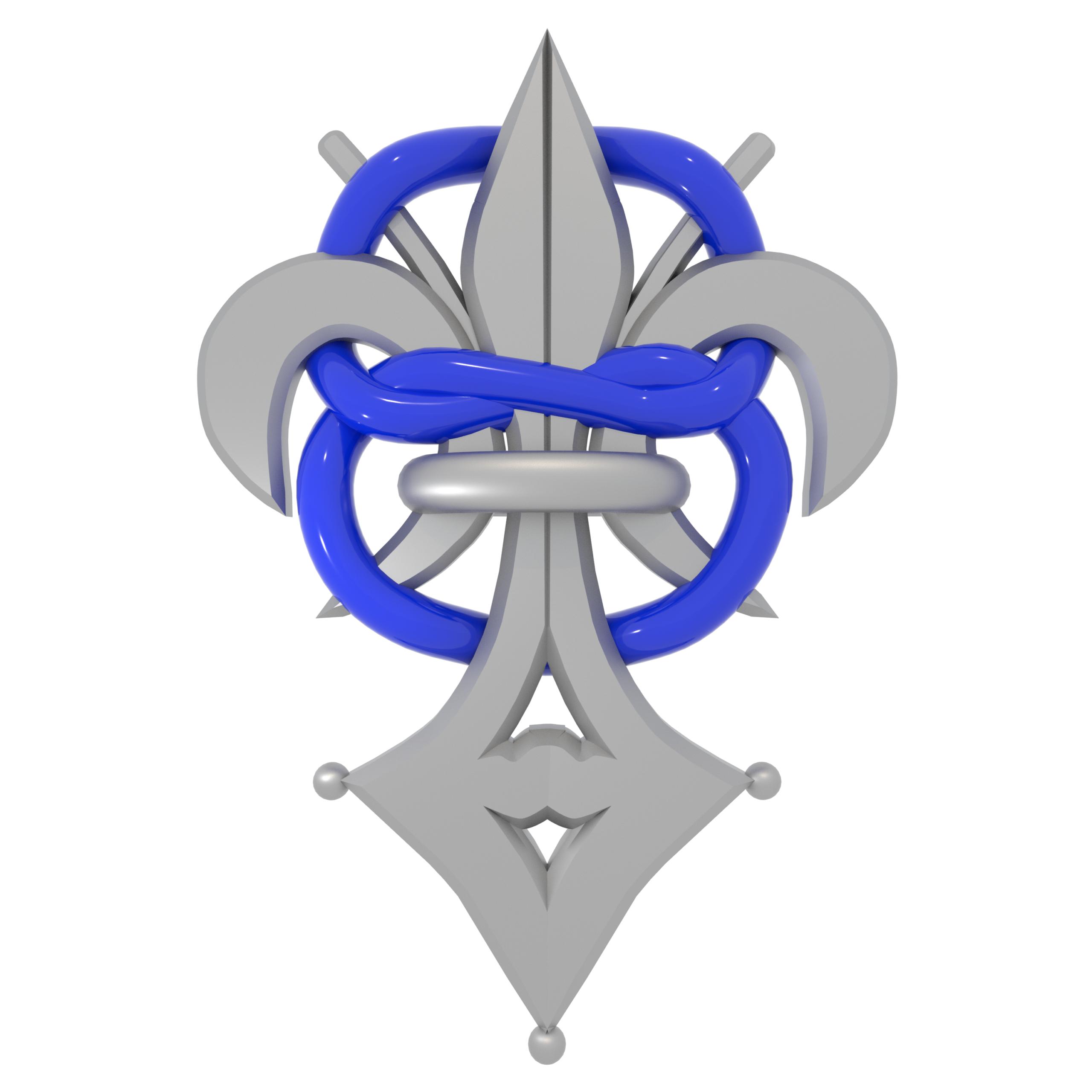
In Europe, during the Renaissance—and more precisely around the beginning of the seventeenth century—the Rosicrucian Movement emerged as a visible heir to the ancient Hermetic tradition, whose historical roots extend far beyond recorded history.
The Rosicrucian current first presented itself publicly in 1614 with the publication of the Fama Fraternitatis Rosae Crucis, followed in 1616 by the equally renowned The Chemical Wedding of Christian Rosenkreutz. These manifestos announced the existence of a fraternity devoted to spiritual regeneration, knowledge, and the inner transformation of humanity.
Throughout the seventeenth and eighteenth centuries, Rosicrucian initiates were already active across Europe. Among them were prominent figures—some openly associated, others operating discreetly—drawn largely from the fields of science, philosophy, literature, medicine, and natural philosophy. Over time, this current expanded beyond Europe, extending its influence worldwide and continuing into the present day.
Rosicrucian knowledge conveys a form of wisdom inherited from ancient Egypt, Babylonian traditions, Pythagorean philosophy, and Jewish mysticism, understood in its gnostic dimension and in the study of the Kabbalah. From this initiatic emanation arose various Rosicrucian Orders, which to this day preserve and transmit this body of knowledge through structured initiation and disciplined inner work.
The Symbolism of the Rose and the Cross
The most powerful and emblematic symbol of the Rosicrucian tradition is the Rose, often placed at the center of a Cross.
The Rose represents the transcendent and symbolic image of the human being who has succeeded in awakening and developing his or her true divine spiritual essence, attaining a state of inner realization and fulfillment on the spiritual plane.
As a symbol, the Rose expresses beauty, love, purity, and grace in their highest form. At the same time, it conveys impermanence, vulnerability, and the fleeting nature of existence, thus establishing a profound parallel with the human condition itself.
The Cross, by contrast, symbolizes the body and the manifest world. It is formed by the intersection of the four elements: water and air on the horizontal axis, earth and fire on the vertical axis. At the very center of the Cross—understood as the point of perfect equilibrium—the Rose may blossom. This center represents harmony, balance, and the necessary condition for true spiritual realization.
The Rose upon the Cross therefore signifies the human being who has fully expressed and realized his or her potential by harmonizing matter and spirit. It is the emblem of the accomplished initiate: one who has mastered the laws of the body while awakening the divine principle within.
To be a Rosicrucian thus means to possess knowledge of the Cross (the corporeal, elemental, and material dimensions of existence) and knowledge of the Rose (the spiritual, inner, and transcendent dimension). Only through the conscious integration of both can true perfection be approached.
Symbolically, there exists a striking correspondence between the Rose upon the Cross and the Holy Grail. The Grail, as a Cup, represents the human body as a vessel, while the Blood of Christ symbolizes the supreme divine spiritual essence. In the same way, the Rosicrucian Cross represents the human body, upon which the Rose—the awakened spiritual essence—blossoms through initiatic work.
In both symbols, the same truth is conveyed: the human being is the vessel of transformation, and through disciplined inner labor, the divine essence may be revealed, embodied, and realized.
Rosicrucian Chivalry and Its Convergence with Knightly Orders
From its earliest manifestations, the Rosicrucian current did not develop solely as a speculative or contemplative path, but also as a chivalric and operative tradition, deeply aligned with the ideals of sacred knighthood. This convergence is neither accidental nor merely symbolic: it arises from a shared understanding of initiation as a discipline of transformation, demanding both inner realization and ethical action in the world.
Traditional knightly Orders—particularly those formed during the medieval period—were never purely military institutions. At their core, they embodied a spiritual vocation, structured around vows, hierarchy, ritual transmission, and an ideal of service that transcended personal interest. The knight was expected to cultivate discipline, loyalty, courage, temperance, and fidelity to a higher principle, often articulated as service to God, Truth, or Divine Order.
Rosicrucian chivalry inherits and refines this model. While the battlefield is no longer primarily external, the initiatic struggle remains real and exacting. The Rosicrucian knight is called to wage war against ignorance, disorder, and inner fragmentation, transforming the self into a harmonious instrument of higher intelligence. In this sense, the sword becomes discernment, the armor becomes ethical integrity, and the quest becomes interior mastery.
Historically, many Rosicrucian initiates operated within or alongside knightly frameworks, whether openly or under veiled forms. The ideals of secrecy, graded initiation, symbolic language, and lineage-based transmission are common to both traditions. Moreover, both emphasize the notion of spiritual nobility, understood not as a matter of birth alone, but as the result of inner refinement and fidelity to a transcendent law.
This convergence finds its most complete expression in initiatic Orders that unite knightly structure with Hermetic–Rosicrucian doctrine, where chivalry is no longer merely an external code of honor, but a living path of realization. In such Orders, the knight is not only a guardian of temporal values, but also a custodian of sacred knowledge, responsible for preserving, embodying, and transmitting a spiritual heritage across generations.
Rosicrucian Symbolism and the Grail Tradition: A Doctrinal Convergence
The symbolic universe of the Rosicrucian tradition reveals a profound and structural convergence with the Grail tradition, particularly as it developed within medieval Christian esotericism and chivalric literature. This convergence is not metaphorical alone, but doctrinal, initiatic, and operative.
At the center of both traditions lies the concept of the Vessel.
In the Grail tradition, the Holy Grail is the sacred receptacle that receives the Blood of Christ—the living essence, principle of regeneration, and divine life-force. In Rosicrucian symbolism, the Cross represents the human body and the manifested world, while the Rose that blossoms upon it signifies the awakened divine essence realized through initiatic work.
In both cases, the message is identical in substance:
the human being is the vessel, and the divine element is not imposed from without, but revealed from within through purification, discipline, and knowledge.
The Grail quest, like the Rosicrucian path, is never a purely external search. The knight who seeks the Grail must first be transformed inwardly. Moral purity, discernment, humility, and perseverance are prerequisites; without them, the Grail remains invisible. Likewise, in Rosicrucian doctrine, the Rose can only blossom at the center of the Cross when the elements are harmonized and the initiate has attained inner equilibrium.
Furthermore, the Grail is often associated with hidden lineages, sacred kingship, and a transmission that survives through secrecy, exile, and symbolic concealment. Rosicrucian tradition mirrors this structure through its emphasis on invisible colleges, silent transmission, and continuity preserved beyond institutional ruptures. Both traditions speak to an initiatic continuity that transcends time, guarded by those who are capable of understanding and bearing its weight.
Doctrinally, the Grail represents realized gnosis, not belief. It is the direct knowledge of divine reality experienced through transformation. This is precisely the aim of Rosicrucian initiation: not adherence to dogma, but the progressive unveiling of Truth through lived experience.
Thus, the Grail and the Rose are two expressions of the same perennial doctrine. One speaks in the language of sacred chivalry and Christian mystery; the other in Hermetic and initiatic symbolism. Both affirm that redemption is accomplished through knowledge, that the human being is the sacred temple, and that the ultimate secret is not hidden in a place, but in a state of being.
The Grail Knight as an Initiatic Archetype
The Grail Knight is not merely a literary figure born of medieval romance, but an initiatic archetype that embodies the essential stages of inner transformation within the Western esoteric tradition. He represents the human being called to transcend ordinary existence through discipline, purification, and the conscious pursuit of Truth.
Unlike the profane warrior, the Grail Knight does not seek conquest, glory, or material reward. His quest is directed inward as much as outward. The journey toward the Grail mirrors the initiatic path itself: a progression through trials, failures, and revelations that gradually strip the seeker of illusion and ego, preparing him to receive what cannot be seized by force.
Central to this archetype is the principle that worthiness precedes revelation. In Grail narratives, the sacred vessel appears only to those who have attained a specific inner condition—purity of intention, moral integrity, and spiritual receptivity. The knight must learn restraint, silence, and right questioning. Knowledge is not granted to curiosity, but to readiness.
Initiatically, the Grail Knight symbolizes the reconciliation of action and contemplation. He is both a man of the world and a seeker of the Absolute. His sword is not merely a weapon, but an instrument of discernment; his shield is not only protection, but fidelity to an inner law. Through this balance, he becomes capable of embodying the Grail rather than merely beholding it.
In this sense, the Grail Knight is the archetype of the initiated human being—one who has integrated body, soul, and spirit, and who has become a living vessel of sacred knowledge. The Grail itself ceases to be an object and becomes a state of being: the realization of divine presence within the purified self.
Templar Symbolism, Rosicrucian Doctrine, and the Grail: A Comparative Analysis
The traditions of the Templars, the Rosicrucians, and the Grail converge upon a shared symbolic and doctrinal foundation, despite their differing historical expressions. Each articulates, through its own language and forms, the same perennial principles of initiation, sacred guardianship, and inner transformation.
The Templar Tradition
The Knights Templar united monastic discipline with martial vocation, forming a chivalric Order devoted to both spiritual and temporal service. Their symbolism emphasizes guardianship—of sacred places, sacred knowledge, and sacred lineages. The Temple itself is not merely architectural, but symbolic of the inner Temple, the sanctified human being prepared to receive divine presence.
The Templar cross represents sacrifice, obedience, and the subordination of the individual will to a higher order. The Templar knight is a guardian, not a revealer; his role is to protect what cannot be exposed without risk of profanation.
Rosicrucian Doctrine
Rosicrucianism internalizes what Templarism guards externally. Where the Templar protects the Temple, the Rosicrucian builds the Temple within. The Cross becomes the human body and the manifest world; the Rose signifies the awakened spiritual essence that blossoms through knowledge, balance, and inner work.
Rosicrucian doctrine emphasizes transformation through gnosis rather than obedience through rule. Its secrecy is not imposed, but organic: knowledge remains hidden because it cannot be understood by those unprepared to receive it.
The Grail Tradition
The Grail stands at the intersection of these two currents. It is both guarded and realized. Like the Templar Temple, it is protected from the unworthy; like the Rosicrucian Rose, it reveals itself only through inner transformation.
The Grail Knight must possess the discipline and purity of the Templar, as well as the interior realization of the Rosicrucian initiate. Only through this synthesis does the Grail become accessible—not as an artifact, but as a living reality.
Doctrinal Unity
Across all three traditions, the following principles recur with striking consistency:
- The sacred is preserved through secrecy and worthiness, not through concealment alone.
- The human being is both guardian and vessel of divine knowledge.
- Initiation requires transformation, not belief.
- True authority derives from inner realization rather than institutional power.
In this light, Templarism, Rosicrucianism, and the Grail tradition appear not as separate systems, but as complementary expressions of a single initiatic doctrine. Each addresses a different dimension of the same path: protection, transformation, and realization.
Together, they articulate a vision of sacred chivalry in which the knight is not only a warrior or a mystic, but a bridge between the visible and the invisible, charged with preserving the continuity of a wisdom that can only be transmitted to those who have become capable of bearing it.