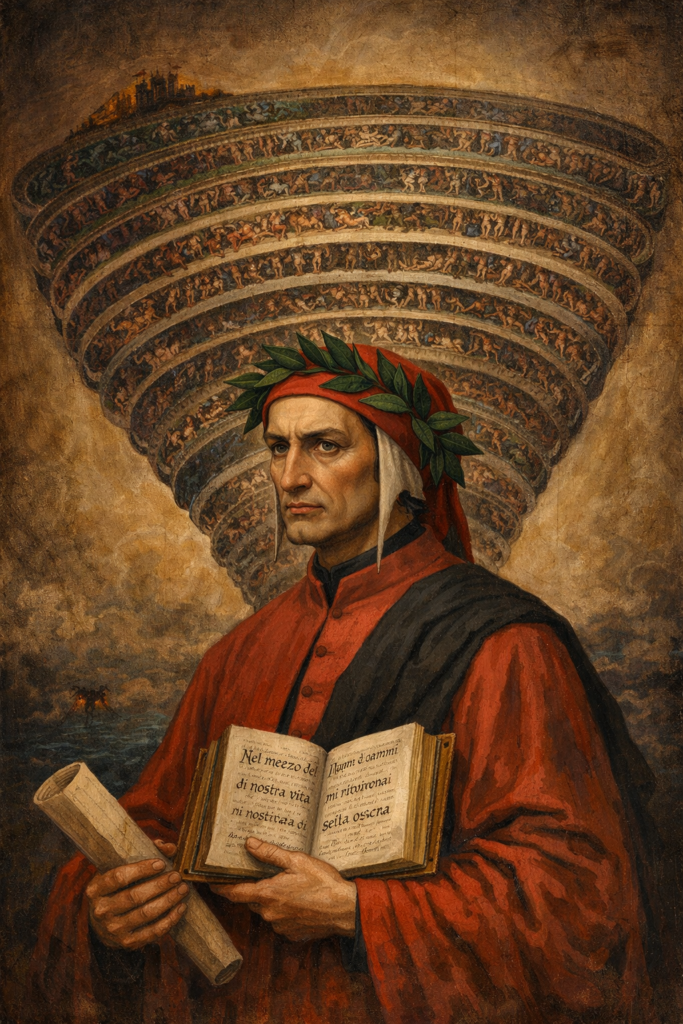

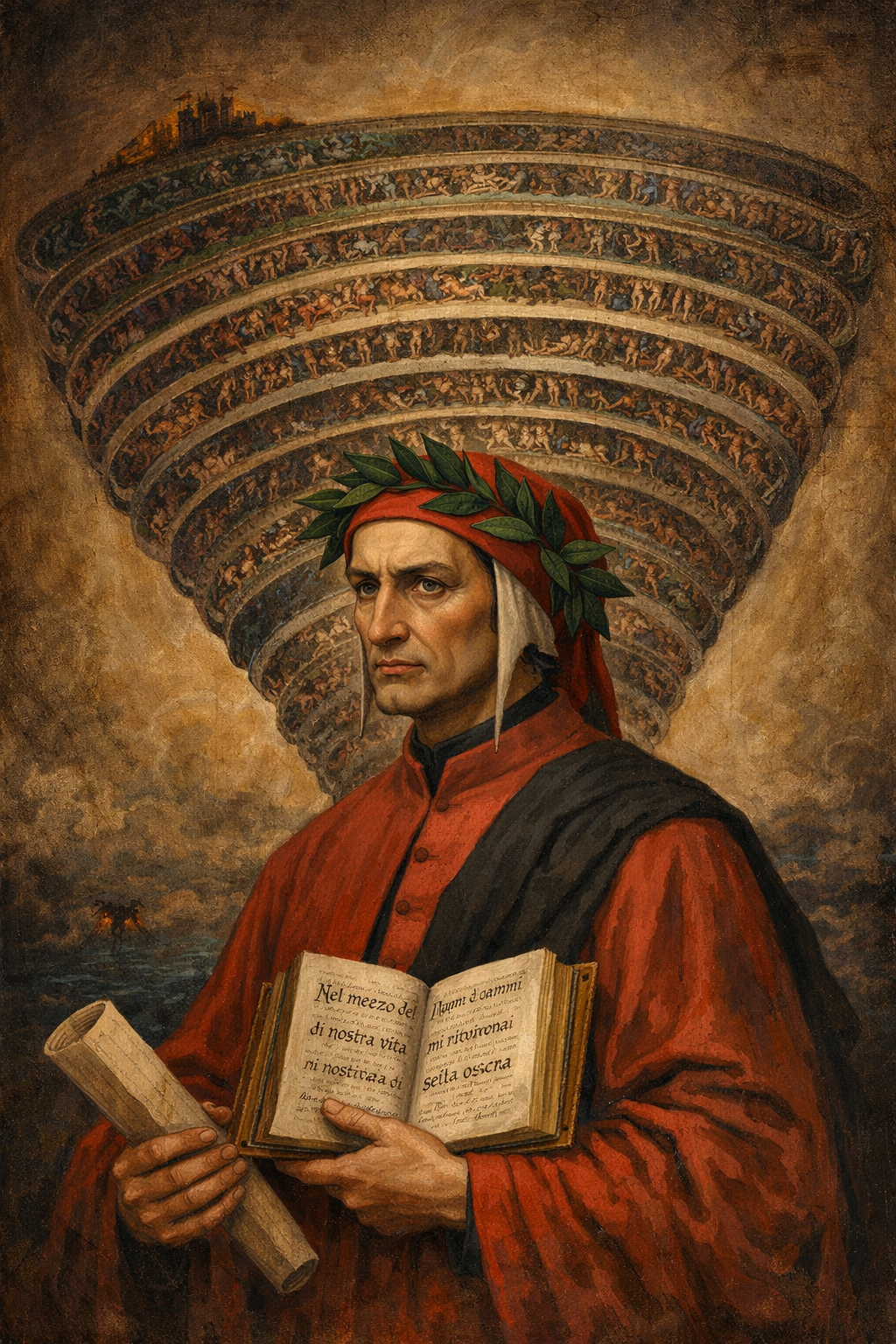
Divine Comedy by Dante Alighieri is examined here as a symbolic representation of the human journey toward spiritual awareness, understood not only in Christian-theological terms but also as an inner process of reintegration of the individual into their authentic spiritual center. Through an allegorical and anthropological reading of the three canticles, this article interprets Inferno, Purgatorio, and Paradiso as stages of a universal initiatory path, in which liberation from excessive identification with external and material reality leads to full inner sovereignty. This interpretation, while firmly grounded in Dante’s text, engages in dialogue with symbolic and initiatory hermeneutic traditions.
1. Introduction: Dante and the Inner Journey of Man
The Divine Comedy is universally acknowledged as a theological, moral, and political masterpiece; however, its enduring relevance lies in its capacity to address the inner condition of human beings across time. Dante’s otherworldly journey is not merely an eschatological narrative but a symbolic depiction of the human path toward self-awareness, understood as the return to one’s inner center.
From this perspective, the Comedy may be read as a true itinerarium mentis: a progressive liberation from an excessive identification with the external, material, and social world—an identification that, especially in modern times, profoundly destabilizes interior harmony.
2. Exteriority and the Loss of the Inner Center: An Anthropological Key
For Dante, the material world is not inherently negative. Earthly experiences, ambitions, and pleasures are integral to the human condition. The problem arises when such realities cease to be instruments and become the core of personal identity.
When individuals define themselves exclusively through what they possess, desire, or receive from external recognition, they gradually lose contact with their authentic nature. This generates an illusory mechanism based on immediate gratification, producing fragility, dependency, and inner instability. What modern psychology describes in clinical terms, Dante renders with extraordinary symbolic clarity.
3. Inferno: The Bondage of Exteriority
Inferno is not merely the realm of eternal punishment; it is the symbolic representation of an interior condition. The damned are condemned because they are wholly identified with their vices: they no longer have sin—they are sin.
In Canto V, the lustful are swept endlessly by violent winds, a powerful image of individuals dominated by impulses they cannot govern. In Canto VII, the avaricious and prodigal push immense weights in futile circles, an unmistakable allegory of a life consumed by accumulation and possession without meaning. Inferno thus embodies the condition of the human being possessed by external objects, where exteriority replaces the inner center.
4. Purgatorio: Awareness and Transformation
Purgatorio represents the decisive moment of awakening. Here suffering persists, but its cause is finally understood. The penitents are no longer fully identified with their vices; they recognize them, confront them, and gradually transcend them.
Time—absent in Inferno—becomes essential. Inner transformation is a process, not an instant. Purgatorio is the realm of responsibility and self-work, where the individual begins to reclaim their inner center while still living within the material conditions of existence.
5. Paradiso: Inner Sovereignty and Harmony
Paradiso does not signify an escape from the world but the realization of mature and sovereign interiority. The individual who completes the journey does not reject earthly life or its goods; rather, they can finally enjoy them freely, without dependency, obsession, or fear.
In this state, external realities return to their proper place as satellites rather than centers of identity. The individual is no longer internally vulnerable or manipulable, because fulfillment no longer depends on something external. Dante’s Paradiso thus represents a state of being even before it is conceived as a metaphysical realm.
6. Guidance, Symbolism, and Initiatory Tradition
Throughout the poem, Dante entrusts guidance to profoundly symbolic figures. Virgil embodies human reason—capable of recognizing error but insufficient for ultimate salvation. Beatrice represents grace and transcendent knowledge. In the final canto of Paradiso, the ultimate vision is mediated by Saint Bernard of Clairvaux, a central figure of medieval Christian mysticism.
Within certain symbolic and initiatory interpretative traditions, the Divine Comedy has also been read as a veiled work, containing layers of meaning accessible only to readers endowed with proper intellectual discernment—explicitly acknowledged by Dante himself (Inf. IX, 61–63). While such interpretations cannot be treated as established historical facts, they testify to the extraordinary multilayered symbolism of the poem.
7. The Necessity of Inferno: An Experiential Pedagogy
A central teaching of the Comedy is that Paradiso cannot be attained without first traversing Inferno. The material dimension, with its risks and seductions, must not be denied but consciously experienced. Only through error can error be recognized and overcome.
Dante thus proposes a rigorous existential pedagogy: no authentic harmony exists without confrontation with disorder, and no freedom without first having known inner bondage.
Conclusion
Read through this lens, the Divine Comedy emerges as a work of extraordinary anthropological and spiritual depth. Dante portrays the human journey from dispersion in exteriority to the recovery of the inner center, from dependency to inner freedom.
In an age marked by excessive identification with possession, success, and image, Dante’s lesson is strikingly relevant: only those who are sovereign over themselves can inhabit the world without becoming enslaved by it. In this balance—fully human and profoundly spiritual—the true “Paradise” is realized.