In France, there exists a church that bears direct witness to a tradition identifying Saint Mary Magdalene as the bearer of a lineage connected to Jesus and intimately associated with the mysteries of the Holy Grail. Through a dense system of symbols and allegories, this church reveals—once carefully examined—the deliberate intention of those who restored and preserved it to establish a clear relationship between the Grail and Mary Magdalene.
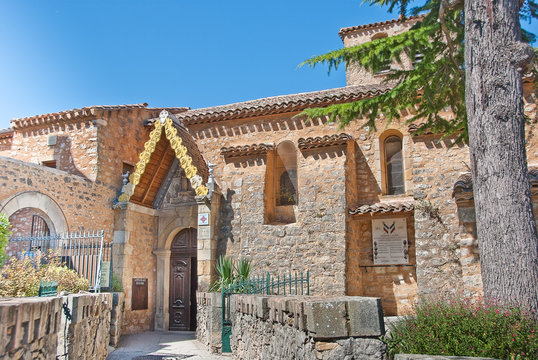
At the same time, the site is traditionally associated with the discovery of significant historical documents that would attest to a connection between the Merovingian dynasty and the bloodline of Jesus. Of this knowledge, only oral tradition and a limited number of investigative elements have reached us today. The original documents themselves are, at present, considered lost, and their recovery remains the subject of ongoing research.
These themes emerge most clearly through an analysis of the Church of Saint Mary Magdalene at Rennes-le-Château.
Historical and Architectural Context
The Church of Saint Mary Magdalene at Rennes-le-Château was consecrated in 1059, originally serving as a private chapel for the Counts of Razès. In the modern era, beginning in 1886, the church underwent extensive restoration under the direction of Bérenger Saunière, the parish priest at the time.
During this restoration, Saunière introduced a remarkable array of symbolic, allegorical, and decorative elements—many of which remain visible today. These features are widely regarded as vehicles for deliberately encoded knowledge, pointing toward specific traditions and concealed meanings rather than mere ornamental excess.
A Convergence of Sacred Traditions
The church, dedicated to Saint Mary Magdalene, stands upon the remains of a Celtic sanctuary traditionally associated with Isis, and its structure reflects a rare convergence of Celtic, Visigothic, and Carolingian influences. This layering of sacred and architectural traditions has produced an edifice of exceptional rarity and coherence, whose present form is the result of successive cultural and spiritual strata harmoniously integrated over time.
The Enigma of Saunière’s Restoration
The cost of the church’s restoration alone has been estimated, in modern terms, at the equivalent of tens of millions of euros. This extraordinary expenditure was borne entirely by Bérenger Saunière, a priest of modest origin who arrived at Rennes-le-Château without personal wealth, relying solely on the small parish stipend customary at the time.
The apparent discrepancy between Saunière’s known means and the scale of the works he financed constitutes one of the central enigmas surrounding Rennes-le-Château and has prompted sustained historical inquiry.
Symbolism within the Church of Rennes-le-Château
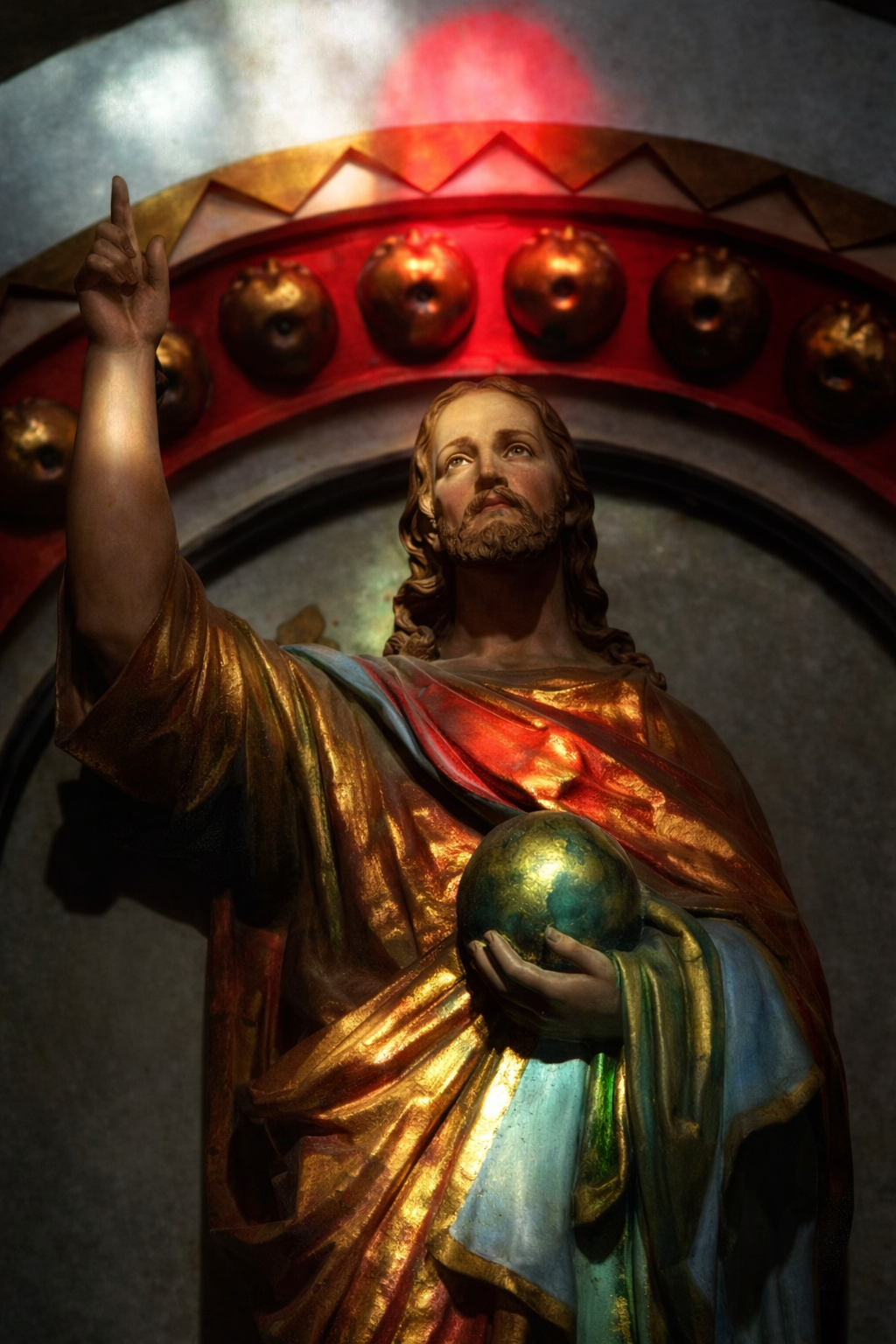
Upon entering the church, one immediately observes that it contains nine principal statues, in addition to the figure of Saint Luke, represented on the side of the pulpit. This carefully selected ensemble forms a symbolic system that has long attracted the attention of researchers.
The figures present within the church are:
- Asmodeus, the demon supporting the holy water stoup, surmounted by four angels
- Saint Germaine
- Saint Roch
- Saint Anthony the Hermit
- Saint Anthony of Padua
- Saint Luke (depicted on the side of the pulpit)
- Saint John the Baptist
- Saint Mary Magdalene
- Saint Mary, Mother of Jesus
- Saint Joseph
The Arrangement of the Statues
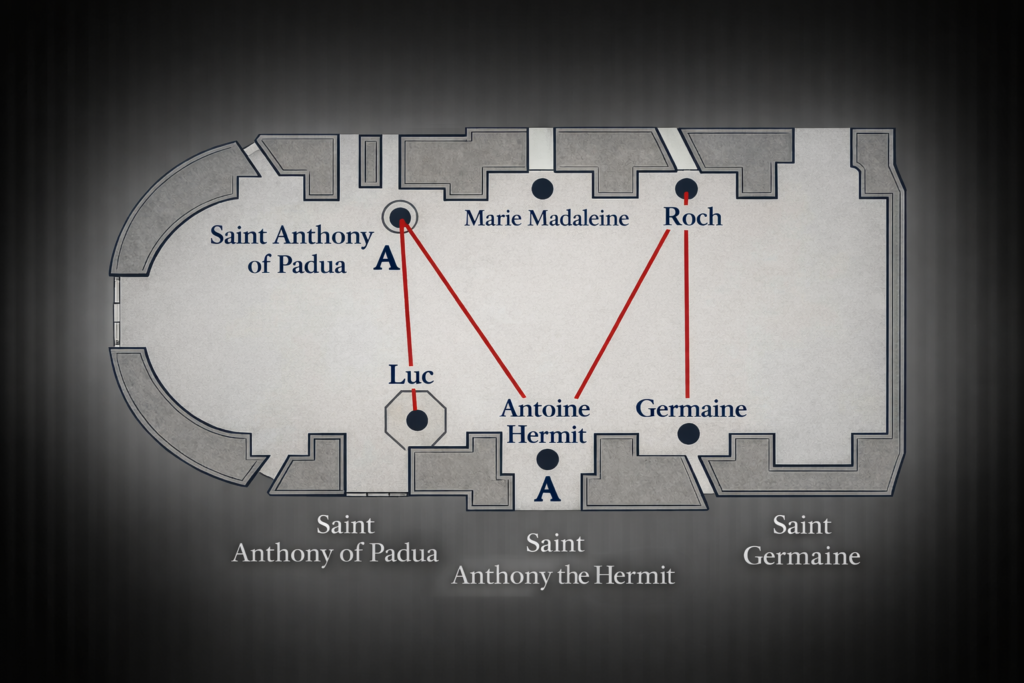
Beyond their individual identities, the spatial disposition of these statues constitutes a central element of the church’s symbolic program. When the initials of the figures positioned around Saint Mary Magdalene are isolated and read according to their arrangement, they form the word “Graal”, while simultaneously outlining the letter “M”, the initial of Maria.
This dual construction—both linguistic and geometric—suggests a deliberate allegorical design rather than a coincidental placement. Within this interpretative framework, the configuration functions as a visual code, accessible only to those capable of discerning its symbolic logic.
Allegorical Intention
Such an arrangement strongly indicates a conscious and intentional choice on the part of Bérenger Saunière, the priest responsible for the church’s modern restoration. Through this symbolic language, Saunière appears to communicate—without explicit declaration—that the Grail was understood as a reality intimately connected to Saint Mary Magdalene.
Rather than conveying this message through direct inscription, the church employs allegory, spatial symbolism, and encoded structure, consistent with traditional modes of esoteric transmission. The symbolism does not impose belief, but invites interpretation, reserving its meaning for those prepared to read beyond the surface of devotional imagery.
The Former Altar and the Pillar Concealing the Parchments
What is known today about the altar that stood in the church in 1885—the year in which Bérenger Saunière assumed responsibility for the parish—is that the high altar consisted of a large stone slab, anchored on one side to the wall and supported at the front by two pillars: one plain and undecorated, now lost, and the other carved with a cross inlaid with gemstones and bearing the two Greek letters Alpha (Α) and Omega (Ω).
It was Saunière’s decision to replace this old altar with a new one that led to the discovery of the now-famous parchments. These documents, found concealed within the structure, constitute one of the central enigmas associated with Rennes-le-Château.
Following this discovery, Saunière relocated the carved pillar from inside the church to the garden, where he placed upon it a statue of the Virgin Mary and added the inscription:
MISSION 1891
Notably, the pillar was installed inverted, deliberately turned upside down. This inversion is widely interpreted as a symbolic act, representing the “double,” the “negative,” or the “feminine” counterpart of the church, now situated in the exterior garden.
As will be examined further, the garden itself was designed as an exact mirror image of the church’s floor plan, and several external furnishings were intentionally inverted in order to affirm this symbolic correspondence. The overturned pillar thus becomes part of a broader system of spatial and allegorical inversion.
The Way of the Cross
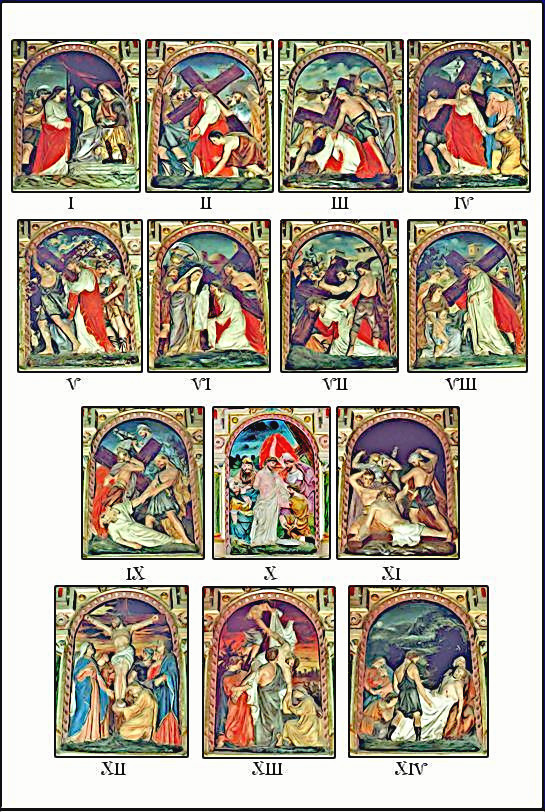
The Way of the Cross within the Church of Saint Mary Magdalene presents a further anomaly of considerable significance. Unlike the vast majority of churches, where the stations are read from left to right, the Via Crucis at Rennes-le-Château proceeds counterclockwise, from right to left.
Public attention has been particularly drawn to the fourteenth and final station, which depicts Jesus being placed in the tomb at night, under a full moon. According to the canonical biblical account—accepted by both ecclesiastical and academic authorities—the burial of Jesus occurred in the late afternoon, not during the night.
This discrepancy inevitably raises a critical question: why is the burial shown as taking place at night? The representation implicitly suggests the possibility that the scene may not depict a burial at all, but rather the removal of Christ’s body from the tomb.
Such a deviation cannot reasonably be attributed to error. Given Saunière’s documented competence in religious history and symbolism, a mistake of this nature is highly implausible. Instead, it strongly indicates a deliberate and coherent intention to transmit a concealed message—one that is simultaneously hidden and revealed through imagery.
A further detail of notable importance is the mountainous landscape depicted on the horizon in the scene, which closely resembles Mount Bugarach, a prominent peak clearly visible from Rennes-le-Château itself. This geographical correspondence reinforces the impression that the imagery was crafted with local and symbolic precision, rather than artistic arbitrariness.
January 17 and the “Blue Apples”:
Astronomical Mechanics and Initiatic Time
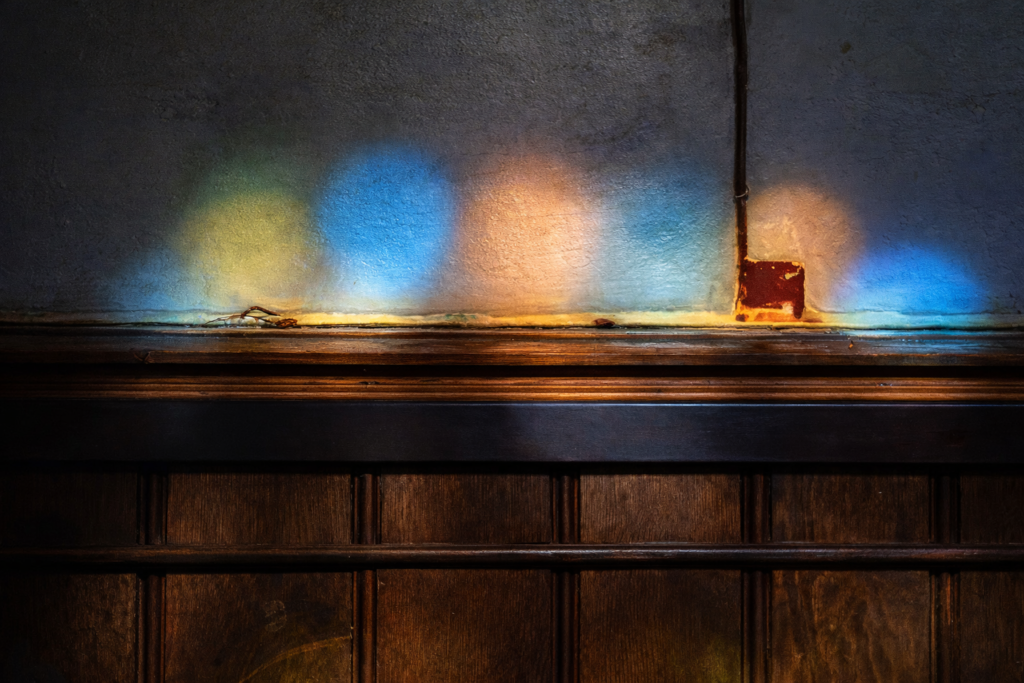
Each year on January 17, beginning at approximately 11:00 a.m., a rare and striking luminous phenomenon manifests inside the Church of Saint Mary Magdalene at Rennes-le-Château. Near the statue of Saint Anthony the Hermit, an ethereal composition of bluish, circular light forms appears projected onto the interior wall. This phenomenon—known as the “Blue Apples”—is observable only on this specific date and remains entirely absent throughout the rest of the year.
Astronomical and Optical Structure of the Phenomenon
The appearance of the “Blue Apples” is not accidental, nor the result of decorative chance. It is produced by a precise interaction between solar position, architectural orientation, stained glass geometry, and wall placement. The church’s axis, window angles, and glass coloration appear to have been calibrated to the solar declination corresponding to January 17, allowing sunlight to enter at a very specific inclination.
As the Sun rises and advances along its winter trajectory, the light passing through the stained-glass window undergoes selective spectral filtering, producing concentrated blue-toned projections. These projections become visible around 11:00 a.m., reach maximum clarity and intensity near 1:00 p.m., and then gradually dissolve as the Sun’s angle shifts.
Such a construction implies:
- a deliberate understanding of solar cycles and seasonal geometry,
- awareness of post-solstitial solar ascent,
- and a capacity to translate astronomical knowledge into symbolic architecture.
The phenomenon persists for a few days following January 17, though with decreasing precision, indicating that the date itself represents the point of optimal alignment, not merely a general seasonal effect.
Allegorical and Commemorative Intention
In keeping with the broader symbolic program of the church, the “Blue Apples” function as an allegorical marker of time, rather than as a purely visual curiosity. The use of light—intangible, transient, and cyclical—aligns with traditional initiatic modes of communication, where meaning is revealed through recurrence and alignment, not through explicit inscription.
January 17 corresponds to the death dates of several figures represented within the church:
- Saint Anthony the Hermit,
- Saint Germaine of Pibrac,
- and Marie de Nègre d’Ables d’Hautpoul, Marquise of Blanchefort-Hautpoul, the last noble interred within the church.
The convergence of commemorative symbolism and astronomical precision strongly suggests intentional design rather than coincidence.
January 17 in Initiatic Calendrical Traditions
Within the tradition of the Prieuré de Sion, January 17 assumes an even deeper initiatic dimension. The date is traditionally identified as the moment of the successful completion of the Great Work (Magnum Opus) by Nicolas Flamel, a figure regarded within the Order as a former Grand Master. According to transmitted tradition, it was on January 17 that Flamel and his wife are said to have attained the Philosopher’s Stone, symbolizing the culmination of spiritual, alchemical, and interior transformation.
More broadly, January 17 occupies a significant position within several initiatic and symbolic calendars:
- It occurs shortly after the winter solstice, during the phase in which light is visibly increasing but has not yet asserted dominance—an archetypal moment of latent regeneration.
- In alchemical symbolism, this period corresponds to the transition from Nigredo to Albedo, where darkness begins to yield to illumination.
- In hermetic traditions, it marks the moment when the invisible work becomes perceptible, though not yet complete.
The recurrence of this date across hagiographic, alchemical, and initiatic frameworks reinforces its role as a symbolic threshold rather than a simple anniversary.
Saunière’s Final Seal of Meaning
The significance of January 17 is further intensified by the fact that Bérenger Saunière himself died on January 17, 1917, a death officially declared by Marie Denarnaud several days later, on January 22. This final coincidence binds the architect of the church’s symbolic program to the very calendrical key he had emphasized throughout the building.
Taken together, the “Blue Apples” phenomenon may be understood as a temporal seal:
a synthesis of astronomy, architecture, symbolism, and initiatic memory, silently reaffirmed each year by the movement of the Sun itself.
Rather than proclaiming meaning through words, the church allows light, time, and alignment to speak—an approach entirely consistent with traditional initiatic transmission, where truth is not stated, but revealed to those who are prepared to see it.