The quest for the Holy Grail is traditionally approached from an initiatic, esoteric, and spiritual perspective, operating primarily within a symbolic framework in which historical events often play a secondary role. In this context, history functions less as a literal record and more as a vehicle for transcendent meaning.
In the present study, however, the Grail is examined also in its historical and genealogical dimension, specifically as a potential and concrete lineage descending from Jesus Christ and Mary Magdalene. For this reason, the investigation deliberately adopts a technical and documentary approach, relying exclusively on historical sources that remain accessible and verifiable. In accordance with scholarly rigor, all elements that cannot be substantiated are set aside.
Through the research presented here—supported by primary sources cited in the text and referenced in the accompanying video material—it becomes possible to demonstrate that the Merovingian lineage did not become extinct, as is often asserted in modern historiography, but rather persisted through the centuries into the present day. The same sources also show that this lineage was repeatedly opposed by the Roman Catholic Church, particularly during periods in which descendants of Clovis attained significant geopolitical power.
What follows, therefore, is not a fictional reconstruction, but a historical reality—one that has indeed been romanticized in recent times and, in certain instances, exaggerated, yet always rooted in little-known but historically attested facts.
The Grail as Sang Réal in Medieval Sources
From strictly historical testimony, it is already in the twelfth century that the earliest sources appear which explicitly identify the Holy Grail with the Sang Réal—the “Royal Blood” of Jesus Christ. These sources assert that, at that time, living descendants of this lineage still existed, demonstrating that the concept of a messianic bloodline was already circulating in medieval Europe.
The first text examined is Parzival, the celebrated work of Wolfram von Eschenbach. Although widely regarded as aucer as a mythological narrative, the poem also functions as a vehicle for esoteric knowledge concerning the attainment of the Grail. Beyond this symbolic dimension, Parzival appears to encode, in allegorical form, fundamental historical and spiritual truths.
In recent decades, historians and specialists have identified precise and remarkable correspondences between characters and locations described in Parzival and real historical figures and places in Languedoc, Toulouse, and Provence. These findings corroborate elements that were already demonstrable through documentary sources, though previously lacking adequate dissemination.
Within this interpretative framework, the principal figures of Parzival emerge as representations of Merovingian descendants.
The Survival of the Merovingian Lineage
Until relatively recently, the majority of official historical literature asserted that the Merovingian dynasty became extinct in 751. However, multiple historical documents decisively contradict this claim.
One of the earliest such documents dates to 754 and consists of an act of vassalage by which a powerful noble of Merovingian lineage was appointed Count of a territory reconquered from Muslim control. The document explicitly refers to Sigebert, described as a “descendant of King Meroveus,” who is named Count of Rouergue following his oath of loyalty to Pepin III the Short. The text specifies verbatim: “Count Sigebert of Merovingian lineage.”
Further investigation reveals a source from 1118 identifying a count belonging to the Merovingian lineage whose ancestors possessed extensive lands in Burgundy. Additional accessible sources confirm that Bernard II, Count of Toulouse, was likewise of Merovingian descent.
Documents preserved at the Abbey of Saint-Guilhem describe William of Aquitaine—also known as William of Gellone or William of Orange in the chansons de geste—as heir to the Dukes of Burgundy and of Merovingian origin through the paternal ancestor Theoderic. Archival materials held at the Historical Archive of the University of Auvergne in Clermont-Ferrand include charters and diplomas confirming Theoderic’s Frankish and royal origins, distinguishing him from the majority of contemporary counts. Parallel information is also found in the Annals of Lorsch.
It is crucial to recall that during the period in which these documents were produced, the Merovingians were the only lineage recognized as legitimately royal.
In this same vein, the biographer Thegan, in his Gesta Hludovici Imperatoris (813), refers to Bernard of Septimania, son of William of Aquitaine, explicitly as a count “of royal lineage.”
Toulouse, the Cathars, and the Grail Narrative
The Counts of Toulouse were therefore Merovingians. Within this dynasty, Count Raymond V maintained close relations with the Cathars, a fact that led to sustained persecution by the Roman Church, which viewed Catharism as a grave threat to its politico-religious hegemony.
The dynasties of the Guilhelmids and Toulouse were interrelated and both of Merovingian origin. Through the marriage of Roger the Tall (Rogier Tagliaferro) and Adelaide of Burlats, was born Raymond-Roger Trencavel, who was likewise persecuted by Rome for his tolerance toward religious plurality and his refusal to suppress heretical communities in his territories. He died during the Albigensian Crusade after being imprisoned in his own castle, where he is believed to have been poisoned.
A growing number of scholars consider that Wolfram von Eschenbach’s Parzival was directly inspired by the life and deeds of Raymond-Roger Trencavel. Clear correspondences have been identified between Parzival, the Fisher King, and other characters, as well as specific locations tied to Trencavel’s historical context.
According to this reading:
- The Grail Castle corresponds to Foix
- Gahmuret, Parzival’s father, represents Roger II Trencavel
- Adelaide of Toulouse aligns with Parzival’s mother
- King Castis corresponds to Alfonso II “the Chaste”
- Repanse de Schoye, bearer of the Grail, reflects Esclarmonde of Foix, renowned Cathar protector
Even the etymology supports this parallel: Trencavel translates as “one who cuts well,” while Parzival signifies “one who cuts through or divides.”
Geography, Architecture, and Literary Precision
The medieval city of Carcassonne corresponds with extraordinary precision to the fictional city of Graharz described in Parzival. It is unique in Europe for its architectural characteristics, including its 56 towers, justifying Wolfram’s description of “endless towers.”
Similarly, the siege of Pelrapeire and Parzival’s encounter with Condwiramurs align strikingly with the castle of Beaucaire, historically the summer residence of the Counts of Toulouse and their vassals. Beaucaire is uniquely situated on the Rhône, matching every detail of the literary description.
The Grail Castle itself finds its counterpart in Foix, situated on a rocky outcrop near water, protected by a drawbridge over the Ariège—an impregnable fortress exactly as described in the poem.
The Fisher King corresponds to Raymond VI of Toulouse, maternal uncle to Raymond-Roger Trencavel, mirroring the familial relationship in Parzival. Beyond kinship, both figures share a reputation for excess and libertine conduct, as well as feudal authority over Foix.
The Church, the Merovingians, and the Question of Lineage
Historically, the Mayors of the Palace, allied with the Roman Church, overthrew the Merovingians. The Pope crowned the Carolingians and formally prohibited—under penalty of excommunication—the election of any king from another lineage, declaring them the sole legitimate royal dynasty of France.
This persistent hostility toward the Merovingians across generations raises unavoidable questions regarding the factors that threatened the interests of the Roman Church.
According to early medieval French traditions, after the death of Jesus Christ, Mary Magdalene, together with Lazarus and Martha, settled in Provence, within Jewish communities of southern Gaul. From Mary Magdalene’s progeny, preserved within these communities, the Merovingians are said to descend. If this genealogical connection is valid, the Merovingians would represent the natural heirs of Jesus Christ.
What is historically certain is that Merovingian lineages descending from the House of Toulouse have survived to the present day.
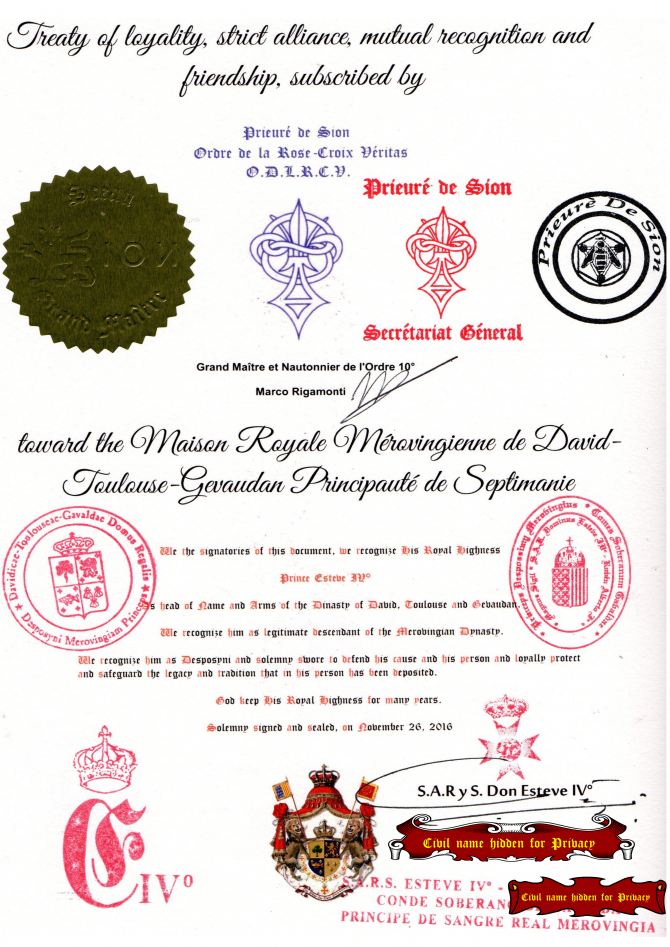
Among these, particular attention is given to the Gévaudan, descendants of the Counts of Autun and Toulouse. In 2016, the Prieuré de Sion signed a treaty of alliance and mutual recognition with Prince Rubén Alberto Gavaldá, a descendant of the Gévaudan, explicitly honoring the bond between the Order and the Merovingian dynasty. The Royal House of David-Toulouse Gévaudan is also referenced in the Almanac of Würzburg 2014.
Further surviving lineages include the Houses of Toulouse and Lautrec. From the marriage of Baldwin of Toulouse and Alice of Lautrec arose the prestigious Toulouse-Lautrec dynasty, perpetuated from 1196 to the present day, as well as collateral branches such as the Lords of Puechmignon, Montrosier, and Lavaur, and the Houses of La Treille, Saint-Germier, and Caylar, several of which continue to exist today.