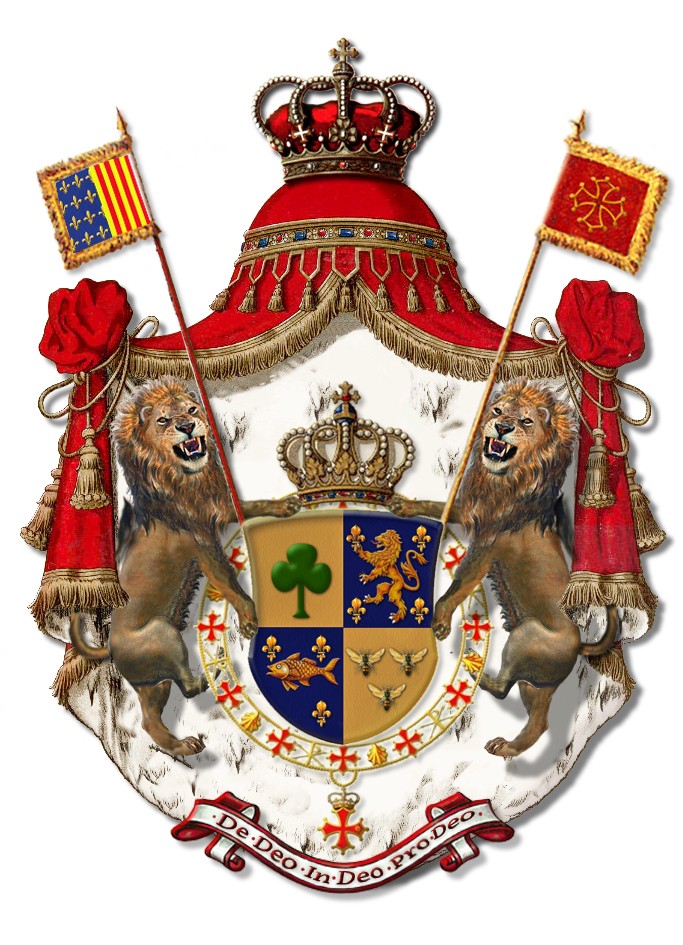
The Prieuré de Sion was legally re-established in 2015 and publicly announced in 2019 during an official event held in Rennes-le-Château.
The event, organized in cooperation with the Municipality of Rennes-le-Château, was expressly dedicated to the refoundation of the Prieuré de Sion and marked its formal re-emergence into public life.
During this occasion, the newly appointed Grand Master, accompanied by Gino Sandri, formally proclaimed, in the presence of the press, the refoundation of the Prieuré de Sion as a legally constituted chivalric order, continuing the initiatic line of transmission associated with Pierre Plantard de Saint-Clair.
During the same event, a charitable donation was presented to the Mayor, Alexandre Painco, to support the restoration of the Church of Rennes-le-Château, which had previously suffered acts of vandalism.
Historical Origins and Merovingian Tradition
Although its legal refoundation is recent, the Prieuré de Sion claims far older traditional roots. According to long-standing tradition, the Order was founded in 1099 by Godfrey of Bouillon, and has historically been associated, in a continuous and symbolic manner, with the Merovingian dynasty.
This relationship with the Merovingian lineage represents a central element of the Prieuré de Sion’s historical and spiritual identity, forming a dual thread that intertwines dynastic heritage and initiatic transmission.
Royal Recognition and Contemporary Status
In November 2016, this historical connection was formally acknowledged and celebrated through official recognition by the Merovingian Royal House of Gévaudan.
This recognition was conferred through H.R.H. Dominus Esteve IV Rubén Alberto I of Gévaudan, last heir of the Gévaudan lineage, a royal house of Merovingian descent tracing its origins to the Counts of Autun and, through Ermengarde, to the Counts of Toulouse.
Today, the Prieuré de Sion stands among the very few chivalric orders worldwide to enjoy the privilege and distinction of formal recognition by a Royal House.
This recognition underscores both its historical continuity and its present-day legitimacy as a legally constituted order rooted in tradition, heritage, and initiatic continuity.